Step 1
Electricity heats the element
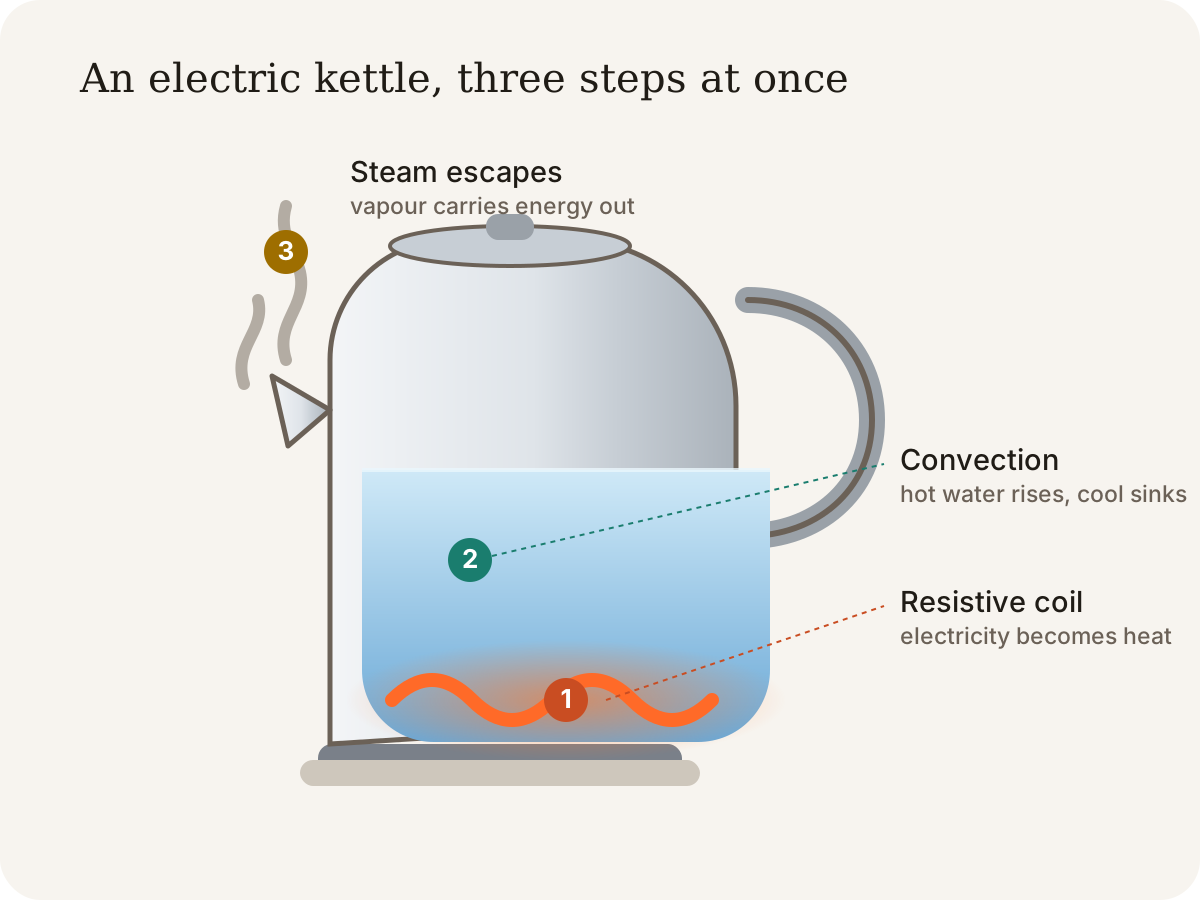
Electrical current passes through a resistive heating element. The element converts electrical energy into thermal energy and transfers it directly to the surrounding water.
Explore object
A kettle brings together resistive heating, convection, phase change, and automatic control in one object. It is one of the strongest entry points into kitchen physics.
What to notice
Step 1
Electrical current passes through a resistive heating element. The element converts electrical energy into thermal energy and transfers it directly to the surrounding water.
Step 2
Water near the hot element becomes less dense and rises; cooler water moves down to replace it. This circulation distributes thermal energy through the full volume — far faster than conduction alone would.
Step 3
Once steam reaches the bimetallic strip in the lid, the strip bends under the heat and trips the switch. The kettle detects boiling indirectly — through its physical consequence — rather than by reading temperature directly.
The physics
Electrical energy becomes thermal energy at the element (resistive heating). Thermal energy spreads through the water by convection. At boiling point, liquid water becomes vapor — a phase change that absorbs latent heat without any rise in temperature while it occurs.
Energy chain
The automatic shutoff is itself applied physics: a bimetallic strip bends when heated by escaping steam, triggering the switch. Two metals with different thermal expansion rates are bonded together — the mismatch in expansion creates the bending force.
See it move
Turn up the burner and follow individual parcels of water: heated water rises through the center, cools near the top and walls, and sinks back down to be reheated. This is the circulation that distributes heat through a kettle.
Common misconception
At standard atmospheric pressure at sea level, water boils at 100°C. At altitude, where atmospheric pressure is lower, water boils at a lower temperature — food takes longer to cook even though the water appears to boil normally. A pressure cooker raises the pressure above atmospheric, pushing the boiling point above 100°C, which allows food to cook faster.
The same principle explains why water can evaporate below 100°C (a wet surface dries at room temperature) and why a pressure cooker lid must be locked: the contents are under enough pressure to be well above what would normally be the boiling point at atmospheric conditions.
Connect the physics
Convection, phase change, and latent heat are all visible in a boiling kettle. It is the canonical starting object for the Heat and Phase lesson.
The element is a metal chosen for stable high-resistance performance under repeated thermal cycling. The housing is polymer — lighter, safer to touch, and cheaper to manufacture.
The heating element is a resistive converter — the same principle behind a toaster or incandescent filament. Electrical resistance and energy dissipation are the shared concept.
Quick check